

What if singing, drawing, dancing, and telling stories from Jewish life could build trust and curiosity in schools? Would you try it tomorrow?
This guide starts with a joyful approach. It turns lessons into living culture. It invites teachers to mix music, art, language, and history.
This makes celebrating diversity in the classroom fun and natural. The goal is to help students see themselves and others.
We offer classroom-ready ideas and a clear plan. Think hands-on stations, song circles, and creative projects. These honor Jewish roots and traditions, while keeping space for all cultures.
Jewish Heritage in a Multicultural Classroom: A Joyful Approach is about joy, respect, and real-world skills.
For inspiration, educators often look at The Jewish Lights Book Of Fun Classroom Activitie. It’s available in PDF, ePub, and Kindle formats. It has a 4.9/5 rating from 1,565 votes.
They also look at arts-forward sources like Shalom Chaverim Orff. It’s available in PDF, ePub, and Kindle formats. It has a 4.8/5 rating from 4,819 votes.
These resources fit K–12 pacing and work well in diverse classrooms.
We also look to the Center for Urban History in Lviv. Its summer school model blends lectures on Jewish history and Yiddish courses. It includes seminars and public-history workshops.
Its open-air exhibition shows how project-based learning and community engagement can thrive in schools.
Across this guide, you’ll find simple steps and adaptable lesson frames. These make a joyful approach doable today. Let’s begin.
Key Takeaways
- A joyful approach uses music, art, language, and story to make learning active and inclusive.
- Celebrating diversity in the classroom strengthens belonging and academic engagement.
- The Jewish Lights Book Of Fun Classroom Activitie and Shalom Chaverim Orff offer ready-to-use activities.
- The Center for Urban History model inspires interdisciplinary, project-based units for K–12.
- This How-to guide is built for United States schools and a friendly tone that supports teachers.
- Small, hands-on steps can honor Jewish heritage while uplifting every culture in the room.
Understanding Jewish Heritage and Its Importance
Jewish heritage is built on history, language, culture, and memory. In U.S. schools, it helps teach Jewish heritage. It also celebrates different cultures in education.
History comes alive when we understand it. The Center for Urban History in Lviv started a summer school in 2009. In 2015, it mixed Jewish history with cultural studies.
Language is key to understanding. A 40-hour Yiddish course in Lviv showed how words carry memories. Teachers can use Yiddish words, texts, and songs to teach.
Culture is seen in public places. In Lviv, people met researchers and went on tours. Schools can do similar activities to connect local sites to Jewish themes.
Teachers need tools to teach. The Jewish Lights Book Of Fun Classroom Activities is one. It makes learning fun and respectful of all cultures.
| Building Block | Classroom Move | Student Outcome | Equity Link |
|---|---|---|---|
| History | Compare migration maps and primary sources | Sense of continuity and change | Multiple narratives honored |
| Language | Introduce Yiddish words via song and short texts | Stronger memory cues and context | Linguistic identities validated |
| Culture | Art, foodways, holiday artifacts | Tangible links to daily life | Respect for traditions |
| Collective Memory | Local heritage walks and exhibits | Place-based understanding | Community voices included |
By combining these elements, teachers make learning fun and inclusive. This way, classrooms teach Jewish heritage and celebrate different cultures.
Embracing Multiculturalism in Education
Real progress in Multicultural learning happens when we mix content, arts, and public life. The Center for Urban History shows how to do this. They have core lectures, seminars, and workshops.
In the U.S., schools can follow the Lviv summer school model. They can use school displays and work with local museums. This makes learning visible and fun.
Learning a new language helps us respect cultures more. An intro to Yiddish shows how language keeps memories alive. Short phrases and songs in class make learning fun and easy.
Hands-on activities make learning fun and easy. The Jewish Lights Book of Fun Classroom Activities has fun tasks. Music and movement activities, like Shalom Chaverim Orff, let everyone join in.
| Element | Purpose | Classroom Example | Equity Benefit |
|---|---|---|---|
| Core Lectures | Give historical and cultural context | Short talks on Jewish urban history with timelines | Shared baseline for an Inclusive curriculum |
| Seminars | Practice comparative analysis | Small groups compare primary sources across cultures | Builds respectful, evidence-based dialogue |
| Workshops | Translate knowledge into public history | Design hallway exhibits and city-space posters | Authentic voice for diverse student authors |
| Language Study | Show how language carries culture | Introductory Yiddish unit with certificates | Validates multilingual identities |
| Music and Arts | Democratize participation | Shalom Chaverim Orff ensemble with movement and speech | Multiple entry points for varied learners |
Small steps matter. Start with a hallway showcase, add a mini Yiddish greeting lesson, and invite a local museum educator for feedback. Over time, these pieces form an Inclusive curriculum that is rigorous, joyful, and welcoming.
Strategies for Teaching Jewish Heritage
Make learning fun to spark curiosity and respect. Focus on values like community, justice, and gratitude. This makes learning Jewish heritage fun and diverse.
Start with hands-on activities. Use books like The Jewish Lights Book Of Fun Classroom Activities. Adapt games and crafts to compare customs.
Language and literacy bring culture to life. Teach Hebrew and Yiddish basics. This helps students grow and see their progress.
Public-history projects build community ties. Have students map Jewish landmarks and write about figures like Ruth Bader Ginsburg. This turns learning into pride.
Music helps with social skills. Use Shalom Chaverim Orff to teach rhythm and teamwork. This approach welcomes everyone’s voice.
Bring in experts to share knowledge. Invite historians and clergy for walks to notice Jewish markers. This connects students to their heritage.
Assess with kindness and clarity. Use portfolios and rubrics to show progress. Reflection journals help students share what they’ve learned.
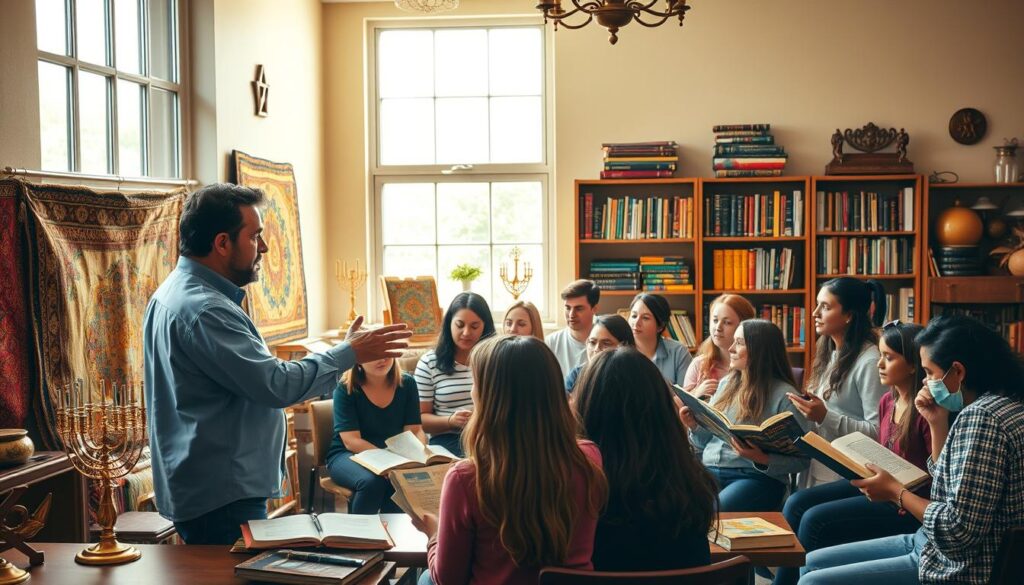
| Strategy | Classroom Move | Skills Gained | Evidence of Learning |
|---|---|---|---|
| Activity-Based Learning | Games, storytelling, and crafts from The Jewish Lights Book Of Fun Classroom Activities | Collaboration, cultural comparison, creativity | Student artifacts, peer feedback notes, quick reflections |
| Language Mini-Lessons | Hebrew and Yiddish greetings, loanwords, signage practice | Vocabulary, decoding, confidence | Exit tickets, pronunciation checks, simple quizzes |
| Public-History Projects | Local landmark maps, biographies, hallway exhibition | Research, writing, civic literacy | Display panels, source logs, audience feedback |
| Music Integration | Shalom Chaverim Orff with rhythm and ensemble work | Listening, teamwork, SEL | Performance rubric, reflection journals, audio clips |
| Field Learning & Experts | Guest speakers, neighborhood walks, museum talks | Inquiry, observation, place-based learning | Field notes, question lists, photo captions |
| Assessment & Reflection | Portfolios, rubrics, certificate-style checks | Metacognition, synthesis, goal-setting | Portfolio reviews, rubric scores, self-assessments |
This plan mixes fun with learning. It makes teaching Jewish heritage engaging and diverse every day.
Creating an Inclusive Classroom Environment
Make your classroom welcoming to everyone. Use simple routines and kind words. Short lessons and quick checks help students feel supported.
Stock up smart. Fill your classroom with books and activities. Include The Jewish Lights Book Of Fun Classroom Activitie, picture books, and audiobooks. Make sure there are large-print materials and visual schedules for everyone.
Let music lead. Use Shalom Chaverim Orff for weekly circles. This lets everyone join in, no matter their language or how they learn.
Put up signs in many languages near the door. Show student work like timeline posters. This makes everyone feel they belong.
Start language lessons with simple goals. Practice in short blocks and then take a break. Tasks should be easy, like labeling things or writing short dialogues.
Discuss Jewish history in a way that connects to other cultures. Use cards, think-pair-share, and walks to keep the conversation respectful.
When talking about tough topics, like the Holocaust, be careful. Use age-appropriate materials and give warnings. Mix serious lessons with fun activities to keep everyone’s dignity.
Daily cues matter. Celebrate small wins. Use sentence starters and peer buddies to keep the classroom inclusive every day.
| Practice | Purpose | How to Implement | Inclusive Impact |
|---|---|---|---|
| Multi-format materials | Access for different learners | Audiobooks, large print, tactile cards, captioned clips | Advances Inclusive curriculum and equity |
| Shalom Chaverim Orff circles | Low-barrier engagement | Call-and-response, steady beat, rotating leaders | Supports neurodiverse and multilingual students |
| Multilingual signage | Belonging and recognition | English, Hebrew, Yiddish greetings at entry points | Centers Cultural diversity in education |
| Structured language blocks | Skill growth with reflection | Set goal, practice, checkpoint journaling | Builds confidence and clarity |
| Interdisciplinary dialogues | Context and empathy | Think-pair-share, gallery walks, prompt cards | Keeps Celebrating diversity in the classroom active |
| Trauma-informed history | Safety around difficult topics | Age-appropriate sources, routines, opt-in reflection | Protects well-being while learning |
Share these ideas with your students. Ask for their thoughts and work together. This way, your classroom stays inclusive and caring.
Engaging Families and Communities
Community engagement makes learning fun and builds trust. Schools can learn from Lviv’s public-history model. They can host family events that highlight student work.
Start with a public showcase. Set up exhibits in hallways or courtyards of student projects on local Jewish heritage. Invite families, librarians, local historians, and Jewish community centers. This makes Multiculturalism in schools real and valued.
Bring in expert voices. Arrange workshops with museum educators or archivists. Short talks followed by Q&A connect the past to the present. This deepens Interfaith education and Celebrating diversity in the classroom.
Host an Interfaith education night. Families share home traditions, like Shabbat candles or Diwali lamps. Tie Jewish practices to wider customs. Keep activities hands-on and brief for all ages.
Show language in action. Plan a ten-minute showcase of greetings in Yiddish or Hebrew. Perform “Shalom Chaverim” with Orff arrangements. This celebrates diversity with music.
Ensure access for all. Provide virtual exhibits and workshops for caregivers at home. Offer resources like The Jewish Lights Book Of Fun Classroom Activities. This makes learning accessible to all.
Community-facing products matter. Street-facing displays or a lobby mini-museum honor local stories. This models Interfaith education and Celebrating diversity in the classroom.
- Courtyard exhibits of Jewish heritage projects with family invitations
- Workshops featuring local historians and librarians
- Interfaith education nights with shared traditions and student-led stations
- Language and music showcases, including “Shalom Chaverim” with Orff support
- Virtual access and take-home guides to uphold Multiculturalism in schools
With clear roles, open doors, and many entry points, families become partners. Students feel seen, and the wider community becomes a classroom. This builds trust and keeps Celebrating diversity in the classroom at the heart of school life.
Resources for Educators
Make a toolkit for Jewish education and multicultural learning. Use classroom materials that save time and bring joy. The Jewish Lights Book Of Fun Classroom Activities is great, with a 4.9/5 rating from 1,565 votes.
It’s easy to use online or download. It’s perfect for all grade levels. Make sure students and families can use it on phones and tablets.
Music is key with Shalom Chaverim Orff. It has a 4.8/5 rating from 4,819 votes. It’s great for classroom ensembles and Orff lesson plans.
Use simple rhythms and movement to help students feel confident. Short rehearsals can be brain breaks. This keeps lessons fun and inclusive.
For your own growth, check out the Center for Urban History in Lviv. Since 2009, it offers summer schools on Jewish history. The 2015 program had a Yiddish course and a workshop on Jewish history in Lviv.
Use these ideas for PD days and PLC agendas. They help deepen Jewish education and support multicultural learning.
Here’s how to use these resources: turn Yiddish course exams into classroom badges. Make projects for public displays to add authenticity. Keep things easy to use and understand. This way, you can make Jewish education fun and support multicultural learning all year.